Designing Affordable Homes In Colorado For Residents & Developers
We celebrate when there’s a real estate boom. Tons of new residents, tons of new businesses, tons of new growth opportunities, and a long shadow most of us don’t consider: tons of folks getting priced out of towns and counties where families have lived for generations.
The lack of affordable homes in Colorado is typically just a passing assessment on a spreadsheet at the state level. But the human impact is much more real. Asher founder and his brother grew up here. They know what it means to have roots here. And they should run just as deep for anyone else who wants to be here.
The American Dream is anchored in people’s ability to provide a home for their families, in a way that enables the new generation to do better than the old. Affordable housing might have a lot of negative connotations to it, but when executed the right way, strained communities can be revitalized, delivering more productivity and lifestyle quality that the spreadsheet decisions don’t account for at the state level.
In this article, we’ll review how Asher Architects & Engineers has partnered with Colorado sustainable housing design firm EcoMod where together, we’re making sure that affordable can still mean beautiful AND sustainable.

The Numbers Behind the Spreadsheet
Interestingly, Colorado’s housing shortfall has actually been shrinking. The state estimates the gap between homes needed and homes available stood at 106,000 units in 2023, the most recent year with complete data, down from a peak of 140,000 units in 2019. That’s real progress, and it didn’t happen by accident. Between 2020 and 2023, the state averaged 43,000 new housing units a year, well above the prior decade’s pace, and that surge alone cut the shortfall by nearly a quarter in just four years.
But here’s the part that doesn’t show up in the headline number. To keep the gap from growing again, Colorado needs roughly 34,100 new homes built every year for the next decade, and those need to be homes people actually live in, not second properties or vacation rentals. Meanwhile, the cost of building has kept climbing and interest rates have stayed elevated, which means even as the raw shortfall narrows, affordable homes in Colorado have become harder to actually afford. Fewer missing units, but a wider gap between what a family earns and what a home costs: progress and pressure, happening at the same time.
Why the Spreadsheet Misses the Point
Every solution to this problem eventually runs into the same wall: land costs money, labor costs money, and the zoning and permitting process in most Colorado municipalities was never built with speed in mind. Lawmakers know this. State housing officials know this. It’s why so much of the policy conversation has shifted toward expanding the kinds of housing that can be built faster and at lower cost without cutting corners on quality, things like accessory dwelling units, missing-middle housing, and modular construction.
But policy can only open the door. Somebody still has to walk through it with a design that works, in a place, for the people who are actually going to live there. That’s the part that gets lost when affordable homes in Colorado is treated as a spreadsheet problem instead of a design problem.
What Sustainable Housing Design Actually Means
Sustainable homes get talked about a lot right now, but the term means more than solar panels and good intentions. Real sustainable housing design is about how a structure performs over decades: how much energy it takes to heat in a Colorado winter, how it holds up under wind and snow load, how long the materials last before they need to be replaced, and how much waste went into building it in the first place.
That’s a materials and engineering conversation as much as it is a design conversation. The homes that solve Colorado’s affordability crisis well are the ones that get both halves right at once: built efficiently enough to be affordable, and built durably enough that affordable doesn’t become a synonym for temporary.
Recently, Asher A&E took on a strategic acquisition to augment an already robust integrated approach. Now, having absorbed a structural steel firm, Asher is uniquely positioned to deliver sustainable home design services in a way that few other firms can.

EcoMod: Sustainable Homes Built in Colorado
This is where EcoMod comes in. EcoMod is a Colorado-based modular housing company that builds accessory dwelling units, single-family and duplex homes, and multi-family units using a foundation of repurposed shipping containers reinforced with a proprietary recycled steel framing system. The company has stated that its construction method results in homes that are over nine times stronger than conventional building methods, with roughly 80% greater wind load tolerance and up to 57% better insulation performance than standard construction, all while meeting or exceeding International Building Code standards. EcoMod’s production facility, located in Hudson, Colorado in the greater Denver metro area, was featured at the 2025 NAHB International Builders Show, a signal of how seriously the broader homebuilding industry is watching what the company is doing.

What makes this approach matter for affordable homes in Colorado specifically is the combination of speed and resilience. Modular construction methods, by their nature, can compress build timelines significantly compared to traditional site-built construction, and EcoMod has built its entire model around proving that compression doesn’t have to mean compromise.
Asher’s Role: Design That Belongs Here
Asher Architects + Engineers has worked alongside EcoMod for several years now, and one of the things we’re proudest of is a project most people never see: we helped design EcoMod’s production facility itself, the building where these homes come to life before they ever reach a Colorado lot.
But the part of this collaboration that means the most to us isn’t the factory. It’s what happens after a home leaves it.
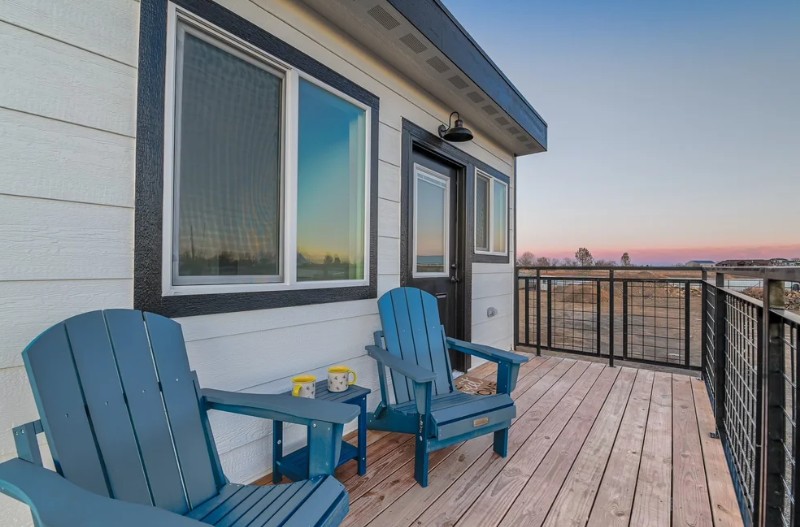
Affordable homes in Colorado don’t have to look “affordable.” Walk through EcoMod’s lineup of ADU, single-family, and multi-family models and you’ll notice something that a lot of modular and container-based housing gets wrong: these homes don’t look like they were dropped in from a catalog. The material choices, the color palettes, the overall design language all carry the same instinct that shows up in mountain modern architecture across Colorado: clean lines, warm and grounded tones, materials that read as substantial rather than disposable. That instinct doesn’t happen by accident in modular construction. It takes a design eye that understands what makes a home feel like it actually belongs on a Colorado lot, instead of looking like temporary housing that just happens to be permanent.
That’s the contribution we’re most proud of in this partnership. Sustainable housing design, done well, should never announce itself as the budget option. It should just look like home.

What This Partnership Points Toward
The state of Colorado has already identified expanding modular and manufactured housing as one of its own strategies for closing the affordability gap. Partnerships like this one are an early answer to what that actually looks like in practice: a design firm and a modular builder working together so that affordable homes in Colorado don’t have to feel like a compromise, for the families who live in them or the developers who build them.
There’s a version of affordable housing that treats the problem as purely financial, four walls and a roof at the lowest possible cost. And there’s a version that remembers a home is still where someone’s kids grow up, where the Christmas card photo gets taken, where a family decides whether this place feels like theirs. Asher’s work with EcoMod is built around the second version. Sustainable homes, built efficiently, designed with enough care that affordable and beautiful stop being opposites. If you’re a developer or a community looking to bring more affordable homes in Colorado online without sacrificing design integrity, we’d welcome the conversation.